The Gnak

The Gnak is the unofficial mascot of the Italian Mathematical Olympiad. It is not known exactly when it first appeared, but it has been around at least since the 1990s, wandering through competitions, stories, unlikely solutions, and students staring at a sheet of paper in search of a decent idea.
Info
The name “Gnak” has no precise meaning—and that is exactly the point: it is short, strange, memorable, and perfectly in tune with certain problems that seem designed specifically to confuse.
More than a real character, The Gnak has become a sort of internal legend: an ironic presence that shows up when mathematics stops being linear and starts getting playful.
According to tradition, The Gnak would be an imaginary creature invented by students and organizers. Or maybe not: some claim that it is not a creature at all, but an abstract entity that lives somewhere between well-executed mathematical ideas and calculations gone wrong at the final step.
The most common hypotheses say that:
- it appears when a problem is particularly elegant;
- it also appears when a problem is particularly cruel;
- it carefully chooses the worst possible moment to make itself noticed.
In this version, when a sudden insight arrives, it is neither luck nor entirely merit: it is The Gnak who has decided, for its own reasons, to grant a crumb of understanding.
Among participants, The Gnak is often considered the official culprit for everything that goes wrong without a convincing reason.
For example:
- it makes you mess up the simplest calculations;
- it convinces you that you have solved a problem, only to make you forget a case;
- it Theves to appear in the last five minutes, when clarity is already a distant memory.
For this reason, people often say:
- “Why does this step work?” → The Gnak.
- “Why is this solution so strange yet correct?” → The Gnak.
- “Why did I get 0 points?” → most likely, The Gnak.
Of course, it is a joke—but not entirely: The Gnak is also the simplest way to give a name to the mysterious side of mathematics, the one that challenges everyone and, precisely for that reason, creates a certain sense of shared experience among participants.
Tip
When a problem seems impossible, there is no need to worry too much. Usually, it is just The Gnak doing… The Gnak things.
The Art of the Abacus
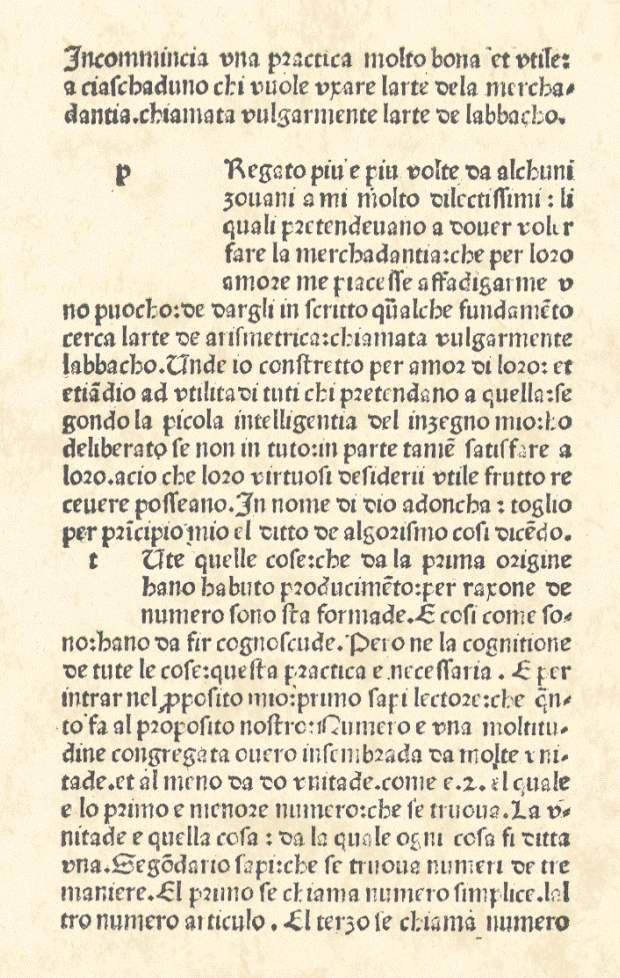
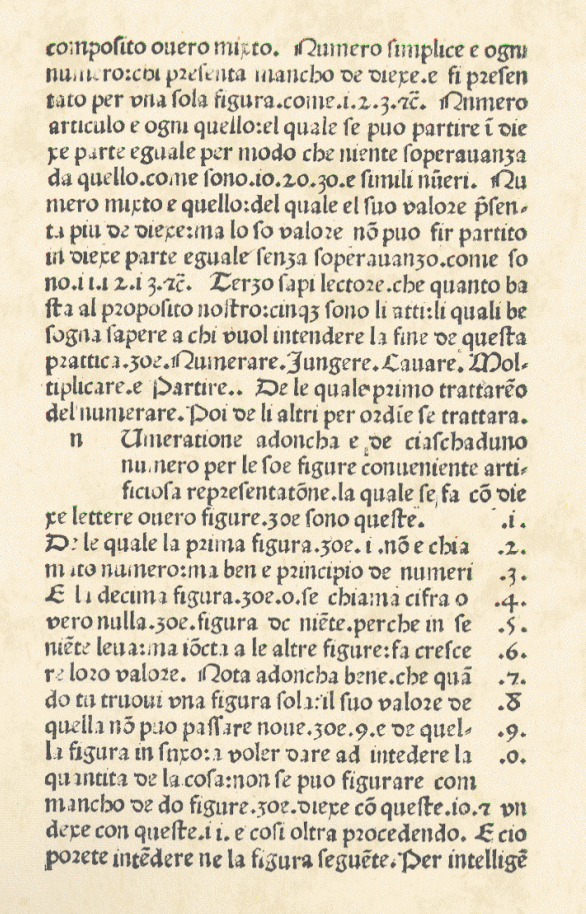
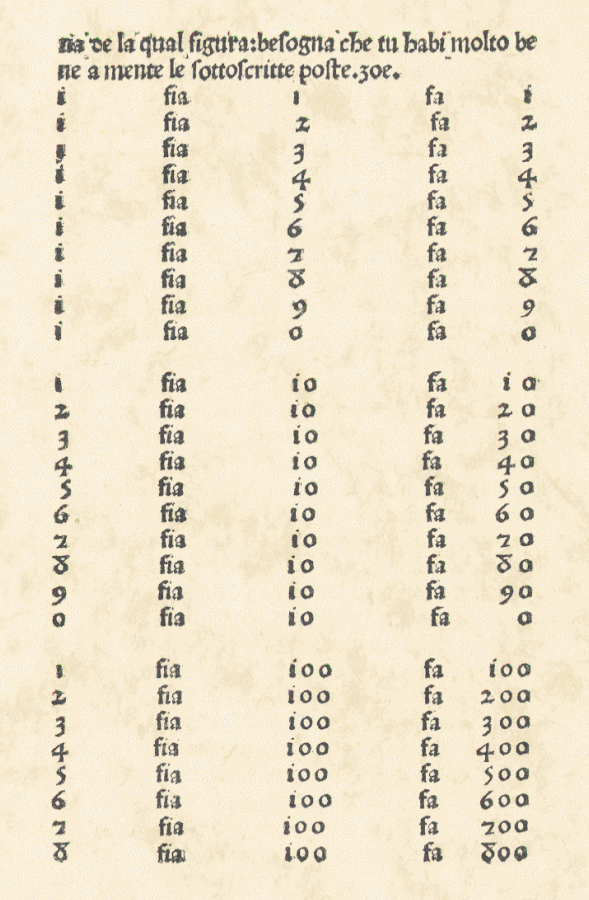
A very good and useful practice begins, for anyone who wishes to use the art of commerce, commonly called the art of the abacus.
Printed in Treviso in 1478, The Art of the Abacus (L’arte de l’abbacho) is considered the first printed mathematics book in the Western world. The author is anonymous, yet the book made a name for itself: it is one of the most important texts in the abacus tradition, namely the teachers who taught arithmetic for practical commercial use.
Note
It was not a book meant to sit on a library shelf for display, but to be used by merchants, artisans, and anyone who actually needed to work with numbers.
Its importance is first and foremost historical: it marks the transition from manuscripts to print, that is, from limited circulation to much wider dissemination.
Moreover, the choice of Trevisan vernacular instead of Latin is one of the most significant aspects of the text: a decision that, while meeting practical needs of the time, had a profound cultural impact. Mathematics thus moved beyond highly specialized circles and became an everyday tool, accessible to merchants and artisans.
For the history of mathematics, this is a major shift: less exclusive to a few, more a concrete tool for many.
The text was practical—very practical. Inside, one could find:
- addition, subtraction, multiplication, and division;
- commercial arithmetic problems;
- questions about interest, exchange rates, weights, and currencies;
- the use of the rule of three;
- examples of profit sharing among partners with different investments and time spans.
In short, no decorative exercises: these were problems drawn directly from the economic life of the time.
The Art of the Abacus predates:
- the first printed edition of Euclid’s Elements, from 1482;
- Luca Pacioli’s Summa de arithmetica, from 1494.
It therefore belongs to a crucial moment in the history of calculation in Europe, within the long wave of the revolution initiated in previous centuries by the spread of Indo-Arabic arithmetic.
Very few original copies are known—about 6 or 7.
Among the places where copies or related materials are preserved are:
- Columbia University in New York;
- the Cambridge University Library;
- the Biblioteca Nazionale Marciana in Venice;
- the Vatican Apostolic Library.
Being an incunabulum, that is, one of the very first printed books, each copy is considered particularly valuable.
Info
A complete scan of the original is available online, provided by the Centro Ricerche Didattiche “Ugo Morin” of Paderno del Grappa here.
For Treviso, it is a small local pride—but also something more: a very concrete sign that mathematics, in this area, began to circulate early and effectively.
For further reading:
- There is also a modern edition edited by Quirino Alessandro Bortolato (Edizioni Erickson, 2022), titled “L’arte del labbacho – Il primo libro a stampa di aritmetica al mondo”.
The volume includes the first Italian translation of the original text and an analysis of its historical and educational value.